Focus and Scope Editorial TeamPeer ReviewersPeer Review Process Author Guidelines Publication Ethics Plagiarism Screening Author Fees Artificial Intelligence (AI) Policy

This policy applies to authors, reviewers, editors and contributors using generative AI, large language models, automated writing applications, AI-based analysis tools or related technologies. AI assistance must remain under meaningful human supervision and must not compromise originality, privacy, legal-source accuracy, intellectual property or the reliability of published findings.
Authors may use AI to support language improvement, organization of ideas, literature exploration, summarization, translation or other appropriate research tasks. AI-generated outputs must be critically checked against authentic legislation, judicial decisions, legal doctrines, empirical evidence and original sources. AI must not replace independent interpretation, doctrinal argumentation, methodological judgment or the authors' substantive scholarly contribution.
Meaningful use of generative AI must be disclosed in a separate AI Declaration or an appropriate manuscript section. The statement should identify the tool or model, its purpose, the tasks performed and the authors' verification and editing.
Suggested AI Declaration
"The authors used [AI tool/model] for [specific purpose]. All AI-assisted outputs were critically reviewed, verified and edited by the authors, who accept full responsibility for the accuracy, originality and integrity of the manuscript."
Basic spelling, punctuation, grammar and formatting checks do not require a declaration. Substantive AI assistance involving content, analysis, translation, research design or visual generation must be disclosed.
AI tools must not be listed as authors or co-authors. Human authors alone are responsible for approving the manuscript, verifying legal sources, ensuring appropriate citation, explaining their methods and responding to questions about research integrity. AI use does not transfer responsibility from authors to technology providers.
Generative AI must not be used to create, manipulate or obscure submitted research figures, images or evidence unless such use forms part of a clearly described research method. Where permitted as research methodology, authors must disclose the tool, model or version, purpose, procedures and appropriate safeguards. Fabricated judicial records, false legal quotations, invented case citations and manipulated evidence are prohibited.
Reviewers must not upload confidential manuscripts, manuscript extracts, supporting files or review reports to generative AI tools. Review reports must reflect the reviewer's own expertise, independent evaluation and scholarly judgment. AI must not be used to generate substantive manuscript assessments, legal evaluations or reviewer recommendations.
Editors must protect unpublished manuscripts, reviewer identities, editorial correspondence and decision records. Confidential materials must not be uploaded to generative AI services. AI must not replace the editor's assessment of legal reasoning, manuscript originality, methodological quality or suitability for publication. Final editorial decisions remain the responsibility of qualified human editors.
Controlled AI-assisted systems may support limited administrative activities such as technical format checks, metadata consistency, duplicate detection, scope matching, reviewer discovery or post-acceptance production tasks. Such uses must comply with confidentiality, privacy, security and human-oversight requirements. This permission does not authorize disclosure of protected manuscripts to public AI services or automated scholarly decisions.
All participants must safeguard personal information, confidential interviews, unpublished legal materials, client records, protected institutional documents and intellectual property. Sensitive information must not be submitted to external AI tools without lawful authority, relevant permission and adequate security safeguards.
Misuse of AI may result in requests for clarification, additional disclosure, revision, rejection or appropriate post-publication action. Serious concerns may be referred to the journal's research-integrity procedures. Correction, Expression of Concern or retraction decisions depend on the evidence and the effect of the violation on the scholarly record.
This policy may be updated as AI technologies, legal requirements and scholarly publishing standards evolve. Revisions should be communicated on the official journal website and implemented consistently across author instructions, review procedures and editorial practices.
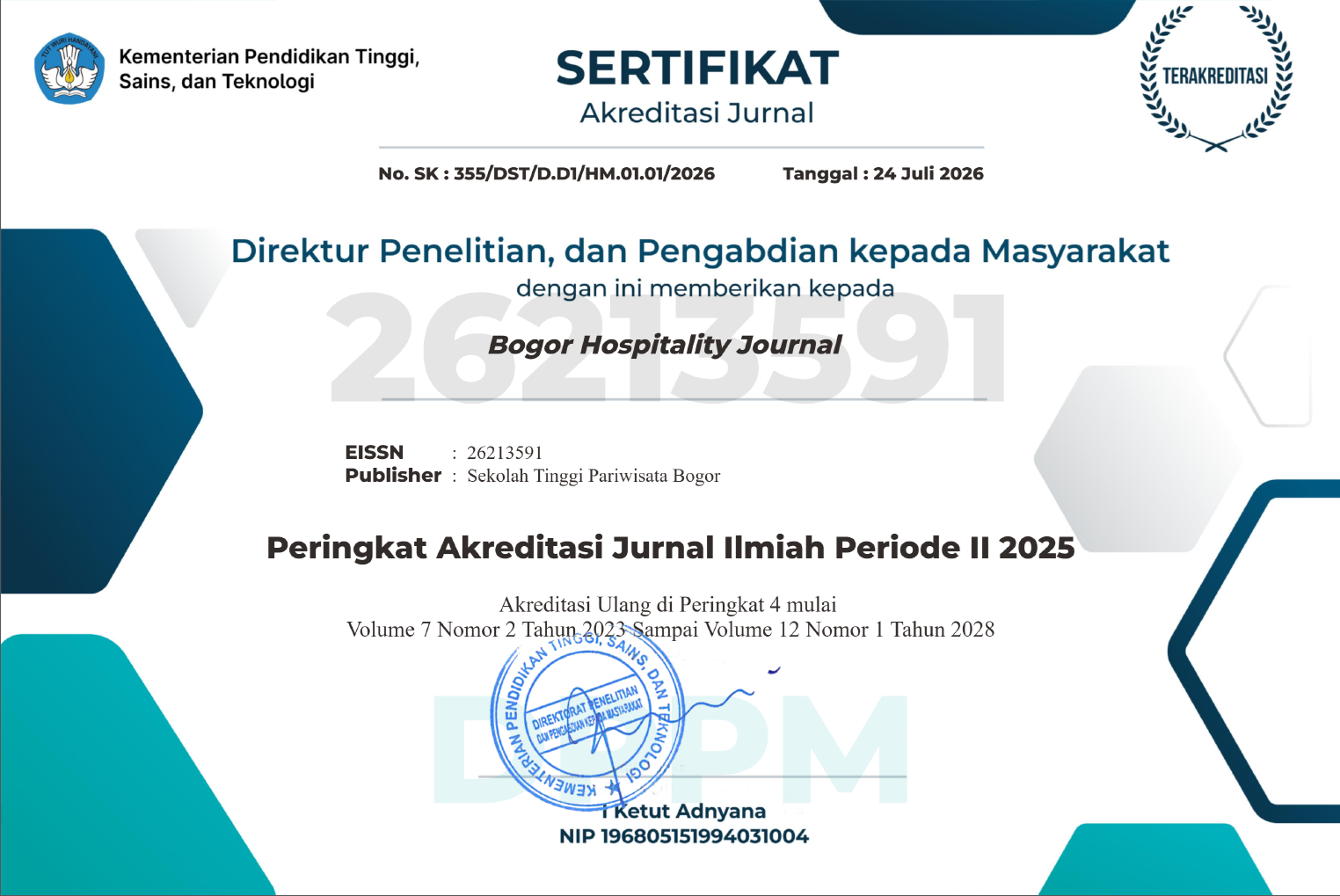
Bogor Hospitality Journal has been accredited by National Journal Accreditation (ARJUNA) managed by Ministry of Research, Technology and Higher Education, Republic Indonesia Fourth Grade (Ranked 4/Sinta 4).
Number : SK No.355/DST/D.D1/HM.01.01/2026 | Certificate
Article Template

Tools


ISSN Cetak

ISSN Online



Alamat Redaksi
LPPM (Lembaga Penelitian dan Pengabdian Masyarakat) Sekolah Tinggi Pariwisata Bogor.
Jl. KH.R.Abdulah Bin Nuh no. 16A Yasmin, Curugmekar. Bogor Barat, Kota Bogor, Jawa Barat, Indonesia, 16113.
Telp. (0251) 7534343, Faks. (0251) 7534513.
Email: lppm@stpbogor.ac.id.
Website: lppm.stpbogor.ac.id

This work is licensed under a Creative Commons Attribution 4.0 International License.


